

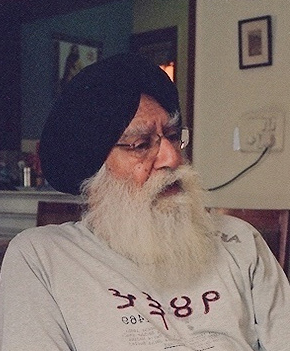
Jitendra Pal Singh Uberoi (b.1934-d.2024) was a renowned sociologist and anthropologist. His was instrumental in establishing sociology as a study in post-colonial India. He is known for his study of European modernity, and extensive understanding of the relationship between science and culture. Uberoi held one of the longest professorships at the Department of Sociology at the Delhi School of Economics in Delhi University. He also established European Studies Program in the department, with the aim to further the study of Western theories and practices from Indian perspective.
J.P.S. Uberoi was born in Lahore, as the son of Mohan Singh Diwana, an eminent scholar of Punjabi literature and culture. He married Patricia Robyn in 1966. He graduated from University College London with a degree in electrical engineering and telecommunications in 1955. Uberoi pursued his masters (1955-1958) in anthropology at the University of Manchester. He completed his PhD in 1964 in the Department of Anthropology at the Australian National University. His thesis was entitled ‘Social Organisation of the Tajiks of Andarab Valley, Afghanistan’. Disciplinary shift between science and humanities resulted in his deep understanding of relationship between science and culture, as reflected in his writings which combine scientific precision with humanistic imagination and observation.
Uberoi started his teaching career at Australia’s Monash University, where he taught social anthropology and sociology from 1963 to 1966. In 1968, he returned to India on invitation of M.S. Srinivas and joined the Department of Sociology at the Delhi School of Economics. He was a reader for a few months after which he joined there as a professor of Sociology in 1969 and taught till 1999. He was awarded the Hocart Prize by the Royal Anthropological Institute, and the Lifetime Achievement Award by the Indian Sociological Society.
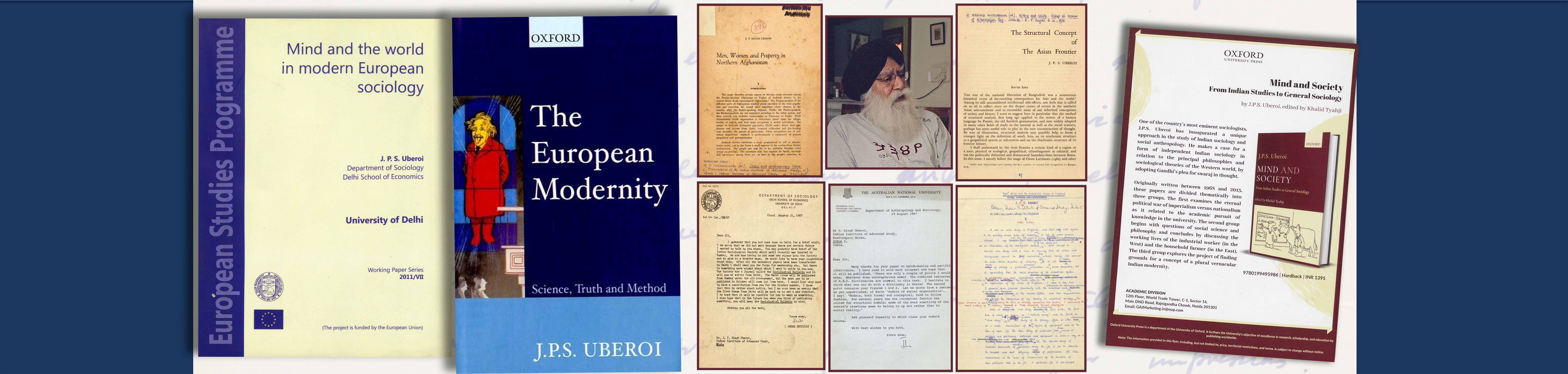
He wrote on a vast array of subjects. They range from the sociolinguistics to atom bomb, from Sikhism and Islam to the structure of the modern university, from swaraj to the life of things, from the nature of frontiers to the theory of colours, from martyrdom to the industrial worker, from civil society to the semiotics of modern science, from the theory of Trobriand potlatch to Andarabi social structure. Some of his books are Science and Culture (1978), The Other Mind of Europe: Goethe as a Scientist (1984), The European Modernity: Science, Truth, Method (2002), and Mind and Society: From Indian Studies to General Sociology (2019).
About the collection : The papers of J.P.S. Uberoi comprise manuscripts of his books, monographs and articles. They constitute material on Indian history, politics, society, economy, science and culture. Additionally, there is material on Afghanistan and South-East Asia. There are writings pertaining to ethnography, anthropology, sociology, general science, dimensions of consciousness, magic, religion, myth, mysticism, Sikhism, Sikh History, and Islam. Includes material related to personalities like Paracelsus, Goethe, Russell, Hegel, Marx, Engles, Lenin, Stalin and others. The papers also contain volumes of Journal of the Royal Anthropological Institute of Great Britain and Ireland, MAN, and The Eastern Anthropologist. The collection is immensely valuable for study and research on religion, caste, culture, society, science and nationalism, especially South-Asian and South-East Asian countries.
Donor: Patricia Robyn Uberoi
Acquisition: 2025